
Staff
Dr. Steven Cooke
Steven Cooke is a Canada Research Professor in the Institute of Environmental and Interdisciplinary Sciences and Department of Biology at Carleton University. Dr. Cooke is the Director of the CEIC. Research in his lab focuses on conservation science, environmental evidence, applied ecology, and the human dimensions of natural resource management. He is particularly active in freshwater and marine systems but has broad taxonomic, geographical, and realm interests. Cooke also serves as Secretary of the College of the Royal Society of Canada, Editor in Chief of the journal “Conservation Physiology”, and a Board Trustee for the Collaboration for Environmental Evidence.
Contact – steven.cooke@carleton.ca
Dr. Joseph Bennett
Joseph Bennett is an Assistant Professor at the Institute of Environmental and Interdisciplinary Sciences and Department of Biology at Carleton University. He is a co-director of the Geomatics and Landscape Ecology Laboratory (GLEL). Research in his lab focuses on conservation prioritization, invasion ecology, optimal monitoring, biogeography and spatial statistics. Dr. Bennett has a particular interest in applied questions regarding management to protect threatened species and invasive species control. He also works on theoretical questions regarding the value of monitoring information and the determinants of community assembly in terrestrial and aquatic ecosystems.
Dr. Vivian Nguyen
Dr. Vivian Nguyen is an Assistant Professor at the Institute of Environmental and Interdisciplinary Sciences and Department of Biology at Carleton University. Her research focuses on the interface of science, society and policy within the themes of environmental change, natural resource management, and food insecurity. Dr. Nguyen is a Mitacs Canadian Science Policy Fellow alumni, and spent two years working in the Office of the Chief Scientist at Natural Resources Canada to better understand the challenges of and opportunities for science policy integration. She continues to conduct research to understand the mobilization of scientific knowledge, as well as other ways of knowing, into decisions, policy, and practice. She also has a particular interest in the human dimensions of environmental issues, including fisheries and other natural resources management, and how human perceptions and behaviours can lead to successful or unsuccessful conservation/management strategies and policy initiatives.
Dr. Trina Rytwinski
Dr. Rytwinski completed her PhD at Carleton University in 2012 working with Dr. Lenore Fahrig in the Geomatics and Landscape Ecology Research Lab (GLEL). There she studied the circumstances in which roads and traffic affect wildlife populations. After taking some maternity leave, she returned to the GLEL as a Post-doctoral fellow with Dr. Fahrig (2013-2016) focusing on two main road ecology themed topics; (1) determining ways to improve knowledge on the influence of mitigation measures on wildlife populations through experiments, and (2) assessing the effectiveness of mitigation measures intended to decrease road related impacts on wildlife through meta-analysis. Trina joined the Canadian Centre for Evidence-Informed Conservation in 2016 where she works as a Research Scientist and project manager conducting evidence syntheses and meta-analyses to help inform various Canadian government agencies. Trina is also a Research Associate, working with Dr. Steven Cooke (Fish Ecology and Conservation Physiology Lab) and Dr. Joseph Bennett (Bennett Lab/GLEL), and Instructor at Carleton University. Trina is endorsed as a Collaboration for Environmental Evidence (CEE) trainer and has co-developed an introductory evidence synthesis workshop.
Contact – trinarytwinski@cunet.carleton.ca
Adrienne Smith
Adrienne earned her MSc in Biology from University of Waterloo in 2014 where she studied the impacts of varying flow from a hydroelectric dam on the food web and critical spawning habitat of Lake Sturgeon and Walleye. She work as an aquatic biologist for the Ministry of Natural Resources in Thunder Bay before she joined the Canadian Center for Evidence Informed Conservation in February of 2019. As a Senior Research Assistant, she conducts evidence syntheses under the guidance of the CEIC’s project managers and following protocols developed under the Collaboration for Environmental Evidence (CEE). She is primarily focused on a systematic review of the extent to which fish passage facilities and culverts allow upstream and downstream passage of fish at barriers.
Dr. Lisa Kelly
Lisa completed her PhD at Carleton University in the Fish Ecology and Conservation Physiology Lab. Her thesis research focused on the gut microbiome and its relationship to the fitness of migrating fish. Prior to her work in freshwater ecosystems, Lisa completed an MSc in Marine Biology at James Cook University in Australia, where she studied coral diseases on the Great Barrier Reef. Lisa joined the Canadian Centre for Evidence-Informed Conservation in 2018 as a research assistant conducting evidence syntheses under the guidance of the CEIC’s project managers on systematic maps relating to the prevalence of antimicrobial resistance genes in aquaculture, as well as the effectiveness of captive breeding programs for imperilled freshwater fish and mussel species. She is currently a senior research assistant involved with identifying trends in conservation funding for projects in Africa, Asia, and Latin America.
Cynthia Cadet
Cynthia completed her MSc in Life sciences at the University of Strasbourg (France) in 2017. Then, she participated in environmental education projects within a non-profit organization. In 2020, she received a master’s degree in environmental management from the University of Sherbrooke and the University of Montpellier. Before joining the Canadian Centre for Evidence-Informed Conservation (CEIC), she worked as a research assistant at the University of Quebec in Abitibi-Témiscamingue where she studied the revegetation of mining sites in the boreal forest. Currently, she is a research assistant at the CEIC helping on a project about the effectiveness of community-based conservation and other types of governance on wildlife conservation and human well-being. She is also involved in a project to identify trends in the funding of conservation projects in Africa, Asia, and Latin America.
Dr. Kathryn Peiman
Dr. Kathryn Peiman completed her PhD at UCLA in 2014 and held a post-doctoral position in the Fish Ecology and Conservation Physiology lab from 2015-2017. Kathryn has worked on fish and bird systems around the world, from seabirds in Hawaii and Alaska, to salmonids in Denmark and British Columbia, to invasive passerines in Australia. After working to help restore native Atlantic Salmon to Lake Ontario for several years, Kathryn is now a Research Assistant at CEIC working on a systematic map of the effects of sea lice on Pacific salmon.
Diji Agberien
Diji earned his MSc in Biology and Data Science from Carleton University, following his BSc in Environmental Science with minors in Biology and Statistics. He is passionate about learning, problem-solving, snowboarding, football (soccer), and the ocean, despite being a self-proclaimed terrible swimmer. He lives by Richard Feynman’s quote: “Study hard what interests you the most in the most undisciplined, irreverent and original manner possible.”
With a longstanding passion for data and its application in understanding and informing the world, Diji has naturally gravitated towards data engineering and data science. He leverages this data-centric expertise to support the scientific endeavors at the CEIC as the centre’s data management and partnership coordinator.
Students
Meagan Harper
Meagan is a PhD student at Carleton University in the Fish Ecology and Conservation Physiology Lab. Her thesis research focuses on the influence of different evidence synthesis techniques (including systematic, rapid, and expert-knowledge reviews) on evidence-based decision-making in conservation, using invasive aquatic plant management as a case study. Prior to starting her PhD, she obtained her MSc in Biology at Carleton in 2021, investigating the impacts of flow magnitude changes due to hydropower on fish abundance and biomass. Meagan joined the Canadian Centre for Evidence-Informed Conservation in 2018, assisting in the conduct of evidence syntheses on a variety of topics related to freshwater conservation and management.
Affiliates
Dr. Nathan Young, University of Ottawa
Dr. Graeme Auld, Carleton University
Dr. Jesse Vermaire, Carleton University
Dr. Susan Aitken, Carleton University
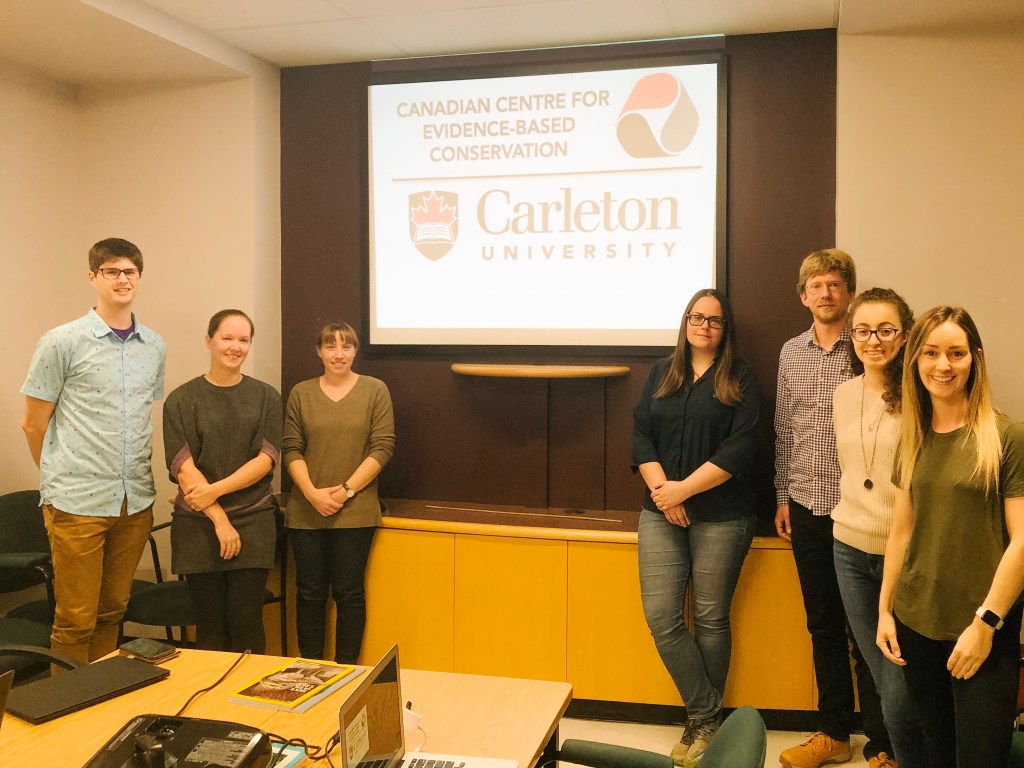
 Canadian Centre for Evidence-Informed Conservation